Last reviewed October 15, 2026. General information, not legal or professional advice. Check the linked sources for the current rules.
The pad height comes from paper
Before any dirt moves, someone has to say how high the finished pad sits. That number comes from the builder's plans and the survey. In a flood zone it's tied to the base flood elevation and the minimum floor elevation the building department will accept, and the drainage plan sets how the ground around the house slopes.
For a head start, look the address up on FEMA's flood map (FEMA Flood Map Service Center). It won't give you a pad height. It will tell you whether flood rules are part of the conversation.
We build to the elevation on the plans. If there's no plan yet, we can still clear the lot, but the pad waits until a surveyor or engineer gives us the number.
Step 1: clear the pad area
Trees, palmetto and brush come off the footprint of the house, the driveway and enough room around them to work. On a pad, the stumps and roots come out too. Buried wood and a thick layer of leaves and mulch rot over time, and fill sitting on rotting material settles. A yard can keep its mulch. A pad can't. Lot clearing covers the clearing side in more detail.
If you're keeping trees near the pad, decide now how far the fill and the machines will stay from them. In unincorporated Brevard the county counts grade changes over a tree's roots, soil compaction and root damage from machines as land clearing (Brevard County Code s. 62-4338).
Step 2: haul off the debris
Everything that came off the pad area gets loaded and hauled away in our dump trucks. That keeps it out of the fill, and it keeps a brush pile from sitting on the lot while the builder waits to start.
Step 3: bring in the fill
Pads around here are usually built from sandy fill. Ask the builder what the plans call for. Many want clean fill, meaning no roots, trash or chunks of debris, and some engineers set a tighter spec than that. The fill dirt, millings and topsoil guide explains the difference.
Fill is counted in cubic yards, and a cubic yard is 27 cubic feet. Multiply the pad's length, width and average rise in feet, then divide by 27. Lots are rarely flat, so the average rise should come from the survey's elevations, not a guess. Fill also packs down when it's compacted, so the amount ordered runs higher than the finished volume. Fill dirt delivery covers ordering.
Step 4: compact it in lifts
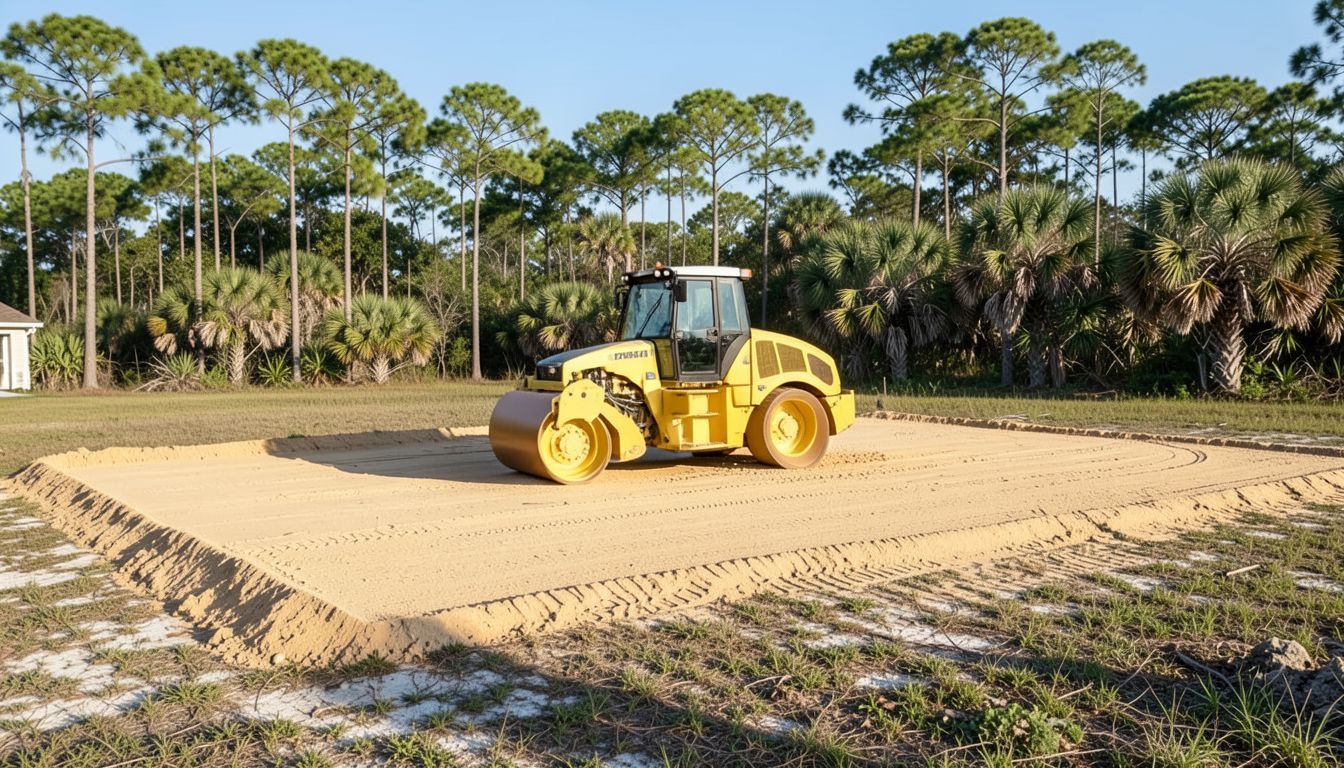
Fill goes down in layers called lifts. Each lift is spread, wetted if it's too dry, and rolled until it's tight before the next one goes on. A roller only packs so deep. Dump the whole height at once and roll the top, and you get a hard crust over soft fill.
The plans or the engineer usually set how thick each lift can be and how dense it has to get. When a builder wants compaction tests, a separate testing firm usually runs them, so tell us up front and we'll have the pad ready when they come out.
Step 5: grade it
The last pass brings the pad to its finished height and squares up the edges. Then the ground around it gets graded so rain runs away from where the slab will sit, following the drainage plan if there is one. Many builders have the surveyor check the final elevation before forming the slab.
What holds a pad up
The dirt work is the predictable part. Delays tend to come from somewhere else:
- A permit that hasn't been issued, or a county clearing permit that ran out before work started.
- A gopher tortoise burrow within 25 feet of the work, which needs an FWC permit first (FWC).
- Buried lines nobody has located. Grading counts as digging, so Sunshine 811 needs two full business days' notice (Sunshine 811).
- Heavy summer rain, which can turn a lot soft and keep loaded trucks off it for a few days.
- No way in. A loaded dump truck needs firm ground, room to turn around and clearance under branches and wires.
Questions people ask
How long does a new pad need to settle before the slab?
There's no single answer. Good compaction in thin lifts cuts settling way down, and the builder or engineer decides when the pad is ready to form and pour.
Can you build a pad without a survey?
We can clear the lot, but we need a target elevation from the builder's plans or a survey before we build the pad. A guessed height ends up either too low or short on fill, and both mean trucks coming back.
Do you pour the slab?
No, that's the builder's side. Our part is the clearing, fill, compaction and grading the slab sits on. Site prep for builders covers how we fit into a builder's schedule.